Click here to enter my other blog: Jane Austen's World.

Saturday, July 31

Georgette Heyer's Regency World by Jennifer Kloester: A Sneak Peek

Sourcebooks is reissuing Georgette Heyer's Regency World by Jennifer Kloester, which will come out tomorrow on August 1. If you click on this link on Scribd you can read the first chapter of this fascinating and very informative book! Here's a very short excerpt:
"The middle class was growing fast in Regency England as increasing numbers of financiers, merchants and industrialists were added to the wealthy doctors, lawyers, engineers, higher clergy and farmers who, among others, comprised the upper ranks of the class. To be in the middle ranks of society usually meant ownership of some kind of property—land, livestock or tools—and the ability to earn a regular and reliable income. The number of servants employed in a house and the type of carriage(s) and number of horses one owned were also useful class indicators, although some among the new middle class, such as the affluent merchant Jonathan Chawleigh in A Civil Contract, tended to mistake opulence for elegance and an excess of food or finery as a sign of wealth and status. But the middle class was a very large and diverse group and it also included shopkeepers, teachers, builders, the lesser clergy, members of the government administration, clerks, innkeepers and even some of the servant class. Property was really the main factor that separated the lowest level of the middle class from the better- off among the labouring poor."

Publisher: Sourcebooks, Incorporated
Format: Paperback, 400pp
ISBN-13: 9781402241369
ISBN: 1402241364

Friday, July 30

Georgette Heyer Event Schedule at Austenprose

Sun Aug 01 Event intro, Werksman Interview, Review of Georgette Heyer’s Regency World on Jane Austen's World and Austenprose

Mon Aug 02 The Black Moth, Aarti – Books Lust; Powder and Patch, Lucy – Enchanted by Josephine

Wed Aug 04 These Old Shades, Keira – Love Romance Passion; The Masqueraders, Helen – She Reads Novels

Fri Aug 06 Devil's Cub, Meredith – Austenesque Reviews; The Convenient Marriage, Laurel – Austenprose

Sun Aug 08 Regency Buck, Susan Scott – Historical fiction author; The Talisman Ring, Ana – An Evening at Almack’s

Mon Aug 09 An Infamous Army, Elaine Simpson Long – Random Jottings of a Book and Opera Lover; The Spanish Bride, Kelly – Jane Austen Sequel Examiner

Wed Aug 11 The Corinthian, Danielle – A Work in Progress; Faro's Daughter, Joanna – Regency Romantic

Fri Aug 13 The Reluctant Widow, Jane Greensmith – Reading, Writing, Working, Playing; The Foundling, Claire – The Captive Reader

Sun Aug 15 Arabella, Kara Louise – Austenesque author; The Grand Sophy, Meg – Write Meg

Mon Aug 16 Interview with Vic – Jane Austen’s World; Friday's Child, Vic – Jane Austen’s World

Wed Aug 18 The Quiet Gentleman, Deb Barnum – Jane Austen in Vermont; Cotillion, Alexa Adams – First Impressions

Fri Aug 20 The Toll-Gate, Laura – Laura’s Review; Bath Tangle, Deb Barnum – Jane Austen in Vermont

Sun Aug 22 Sprig Muslin, Laura – Laura’s Reviews; April Lady, Becky Laney – Becky’s Book Reviews

Mon Aug 23 Sylvester, or the Wicked Uncle, Laurel Ann – Austenprose; Venetia, Laurel Ann – Austenprose

Wed Aug 25 The Unknown Ajax, Brooke – The Bluestocking Guide; A Civil Contract, Elaine Simpson Long – Random Jottings of a Book and Opera Lover

Fri Aug 27 The Nonesuch, Marie – Burton Review; False Colours, Kristen – BookNAround

Sun Aug 29 Frederica, Nicole – Linus’ Blanket; Black Sheep, Katherine – November’s Autumn

Mon Aug 30 Cousin Kate, Chris – Book-A-Rama; Charity Girl, Dana Huff – Much Madness is Divinest Sense

Tues Aug 31 Lady of Quality, Elizabeth Hanbury – Regency romance author; Heyer Vintage Covers

Event wrap-up

Sat Sep 07 Giveaway winners announced


Thursday, July 29

And the contest winner is ...

Gentle readers, in late June Raquel Sallaberry of Jane Austen em Português celebrated her blog's 2-year anniversary by holding a contest giveaway titled, Who Will Marry Mary? We announced a winner who did not step forth. We have spun the random wheel generator a second time and come up with a new winner, Laurie Michael. Laurie, please contact janeaustensworld *@* gmail *dot* com to claim your prize. Click here to recall the contest.

Wednesday, July 28

Georgette Heyer Celebration at Austenprose

‘Celebrating Georgette Heyer’ at Austenprose – August 1st - 31st, 2010

Stylish, witty and historically accurate, novelist Georgette Heyer has been delighting readers with her romantic comedies for eighty-nine years. In honor of her birthday on August 16th, Austenprose.com www.austenprose.com will feature a month long event ‘Celebrating Georgette Heyer’ featuring thirty-four book reviews of her romance novels, guest blogs, interviews of Heyer enthusiast from the blog-o-sphere, academia and publishing and tons of great giveaways.

Vic (that's me) of Jane Austen’s World and Jane Austen Today, and Deb Werksman, acquiring editor of Sourcebook Casablanca and the catalyst in re-introducing Heyer to a new generation of readers will be interviewed for their knowledge about the author.

The festivities start August first with a review of the newly re-issued Georgette Heyer’s Regency World, by Jennifer Kloester. Don’t be a wet goose. Chase away that fit of the blue-devils by attending this bon ton affair.

Click here to enter Austenprose

Monday, July 26

WATER ! ! ! ! ! in Jane Austen's Era

Depending on where we live in the world water can be taken for granted or it can be the cause for a fight for life. In Jane’s time water was always plentiful where she lived in Southern England but it was a struggle to get and to use.

South Downs at Selborne Near Chawton

Water is integral to our very existence. Our bodies need water to stay alive. We need water to grow food. We cook mostly with water. Water can create energy and we need it for hygiene and for cleaning.

Oil, that creator of controversial issues, is running out. We need to cut down on carbon emissions because our climate is being irreparably damaged and water is going to be, is becoming, the most valuable commodity on our planet. Wars will be fought over it.

Here in Europe, as far as water goes, the Northern part of Europe is rich in water supplies. Climate change may well give us too much water. However, Southern Europe, the Mediterranean regions of Italy, Southern France, Spain, Greece and the North African countries are becoming more and more desertified. This means populations will want to migrate north to where the water is. This will cause pressures on populations and maybe even wars, civil wars, as people fight for land and water.

In 1809, Jane, with her mother, Cassandra and Martha Lloyd moved to Chawton. Claire Tomalin in her biography of Jane tells us that Edward, Jane’s brother, who was the owner of The Great House and many properties and much land in the area, had the cottage renovated and improved for his sisters and mother.
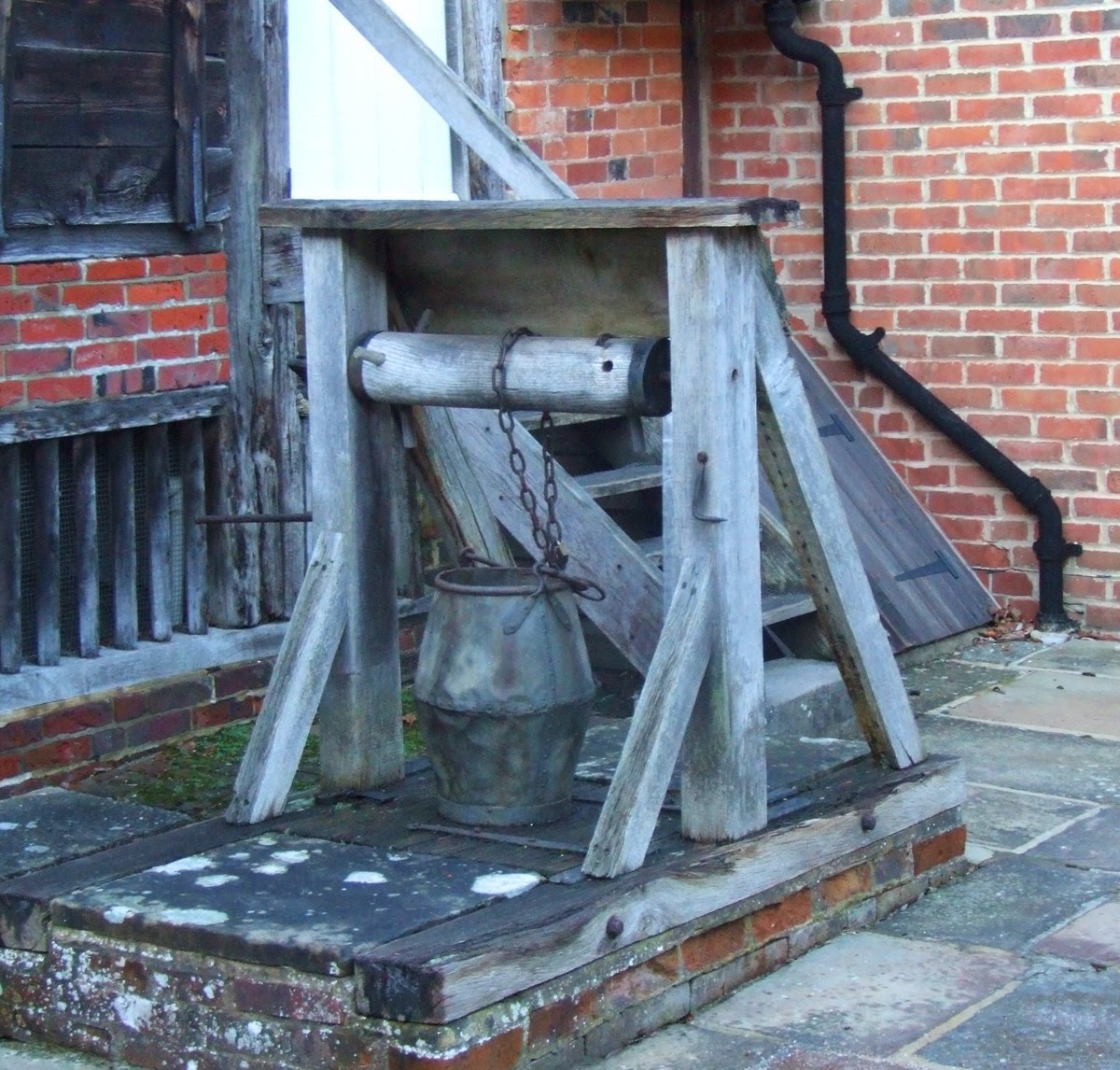
The well at Chawton Cottage

“ Before the ladies arrived, Edward had the plumbing renewed for them. This did not mean indoor sanitation, of course; some town houses had water closets by then – Henry’s and Eliza’s perhaps – but you did not expect the luxury of piped water in a country cottage. An improved pump at the back, and a better cess pit for the privy, well away from the house would be enough.”
And, a new well was dug in the backyard.

How was water used in the cottage at Chawton by Jane and her family?

Kitchen hearth and table at Chawton Cottage

In the backyard you can see the well with the bucket winched up to the top. It is a large zinc bucket which would have held a large quantity of water.It would have taken some strength to wind it up from the depths of the well and then be carried to the kitchen for it’s various uses.

How did the water get to the bottom of the well and what would it have been like?

Chawton is situated in mid Hampshire amongst the South Downs which consist of chalk. It is just north of the clay beds and gravel deposits of the southern part of Hampshire. Rainwater running off the ground, into streams and rivers and water seeping into the stratas of chalk, clay and gravel, which underlie the landscape of Hampshire, absorb the minerals from the ground it permeates. In Hampshire we say we have hard water. This is because a lot of chalk and other minerals are dissolved into it. This is not a bad thing and it could be argued that certain minerals are good for our bodies but it makes the water difficult to use. Cooking with it creates a lot of lime scale on utensils, which need to be cleaned, with difficulty. Lime scale is a hard calcareous deposit and can be almost like concrete. I know, I have to clean my electric kettle out every now and then.
Another view of the kitchen

Cooking itself is not a problem but washing is. Hard water takes more soap to create a lather and washing clothes by hand in tubs using wooden dollies or latticed washboards takes longer. It also needs more strength and is more likely to make the skin on the hands and fingers raw. The north of England and the West Country has the purer softer water. The rock substrata are granites, and millstone grits which are hard tough volcanic rocks and not easily dissolved in water so the water in those areas stays softer and is less full of minerals.

View of the stable yard from the kitchen window at Chawton

Jane lived in a hard water area and so had to contend with the difficulties of hard water. Next week I will continue in this vein and discuss washing and personal hygiene.

Posted by Tony Grant, London Calling

Sunday, July 25

Jane Austen Regency Food Throwdown

If you are reading this post on a full stomach, you might wish to wait before taking this week's poll. Food in the Regency era was varied, to say the least. Tastes in food and drink have changed radically. Whole animals were served at table, for example, such as peacocks or pheasants with heads attached and their tail feathers spread open. While many foods during Jane Austen's era are still recognizable and eaten (roasts, soups, trifles), there are some foods that are no longer popular. Of the following foods served during Jane Austen's day, which would you be most willing to try? You may choose several or tell us why you chose none.


The fried songbirds with bird's nest plate presented to Amanda Price in Lost in Austen

Regency Foods You Are Willing to Try
Pigs Snouts
Offal
Magotty Cheeses
Chicken Hogs Tongues
Cock's Combs and Testicles
Boar's Head Stuffed With Udders
Fried Whole Song Birds
pollcode.com free polls


Roasted Chicken Garnished With Cock's Combs


Saturday, July 24

Pride and Sensibility: Now Here's a Jane Austen Mash Up that Would Interest Me

Kenilworth Theatre Team Take on Austen Mash-Up Challenge

Actors from the Talisman Theatre in Kenilworth will be performing Pride and Sensibility - a combination of Jane Austen's two novels, Pride and Prejudice and Sense and Sensibility - only two days after seeing the script. Featured characters are Mr. Darcy, Lizzy Bennet, the Dashwood sisters and Wickham and Willoughby. Read more about the production in the above link.

Tickets to the show at 7:30 pm on Sunday, July 25, cost £7.50 each. The proceeds will go to Side by Side, a charity which supports the education of children with learning disabilities alongside those without. There will also be a 'silent' auction in the theatre foyer.

Samantha Harris, Jack Linstead, and Emmat Tuff

Call 0788 6415129 or go online at www.talismantheatre.co.uk
Leamington Spa,
Barrow Road, Kenilworth

Thursday, July 22

Follow Friday:The English Heritage Collection

The website for English Heritage Images features the photographs from English Heritage. For the connoisseur of grand British houses and places, this site is a treasure trove. Find information on England's Heritage collections, landscapes, architecture, historic images, and fine art. While publishable versions of the images must be purchased the images available on the website provide the viewer with excellent glimpses of the topic. Above are a small portion of the choices available for the Georgian Architecture Collection.

The Cook Book Collector: A Modern Take on Sense and Sensibility

"Cookbook Collector" Updated Austen Hits the Spot was showcased on Fresh Air yesterday by Maureen Corrigan. Click here to listen to the podcast or read the transcript of the interview with author Allegra Goodman.

Goodman describes this book as "A Sense and Sensibility for the Digital Age." "The story revolves around two sisters: Jess, a beautiful 23-year-old graduate student in philosophy, hops impulsively from passion to passion. In contrast, we're told that Jess's older sister, Emily, is "possessed of a serene rationality." Much like modern versions of Marianne and Elinor Dashwood, n'est pas?

The following excerpt from the book sits on the NPR site:
Yorick's was not always the kind of adventure George wanted. Good help proved elusive. Graduate students, budding novelists, future screenwriters, manic-depressive book thieves — he'd seen them all. With a kind of gallows humor he had printed up a questionnaire that he distributed to those seeking employment. When Jess had turned up, inquiring about a part-time job, he showed her the dark crammed store, the thicket of history, philosophy, and literary criticism in the center, fiction all along the walls and trailing into the back room where random stacks cluttered the floor. Then he returned to his desk and handed her his printed list of questions.

"Could I borrow a pen?" Jess asked, after digging in her backpack and turning up a handful of change and a warped chocolate bar. She was young. She had the clear- eyed beauty of a girl who still believed that, as they used to say, she could be anything she wanted to be. Of course she would not consider herself a girl. The word was offensive, but she had a girl's body, delicate shoulders, and fine arms, and like a girl, she had no idea how fresh she looked.

George handed Jess a black ballpoint, and she took the questionnaire and filled it out right on the other side of his desk. He tried not to stare, although she was leaning over. Casting his eyes down, he resisted the impulse to turn up the sleeve covering her writing hand.

When Jess finished, she returned the questionnaire and waited, expecting George to read her answers right away. He ignored her. When she hovered longer he said, "Give me a couple of days and I'll call you."

But he read the completed questionnaire as soon as she left.

1. Full name: Jessamine Elizabeth Bach

2. Are you a convicted felon? No

3. Are you an unconvicted felon? Not to my knowledge

4. Are you currently taking or dealing illegal drugs? No

5. Are you sure? Pretty sure

6. Circle one. A bookstore is: a meeting place, a mating place, a research room, a library, or a STORE, as the name suggests. Store for convicted felons?

7. Circle one. It's acceptable to wear earphones or use cell phones or notebook computers at work: rarely, sometimes, if I am daytrading, NEVER. Own none of the above

8. Circle one. It's acceptable to take money from the register: rarely, sometimes, if I really need to pay my dealer, NEVER. Wow, sounds like you've been burned. Sorry!

9. Short answer: No more than three sentences, please. Why do you want to work here? I want to work here because I really need the money for day-trading (just kidding). I love books and am well qualified to talk about them if you need someone knowledgeable. You have a great philosophy section, and as I mentioned, I am a grad student in philosophy.

10. Why in your opinion is this store named Yorick's? Hmm. I think this is a trick question. You want us to say because of "Alas, poor Yorick" in "Hamlet," but I can tell from looking at you that you are one of those guys who reads "Tristram Shandy" over and over again, so I'm guessing you named the store after Parson Yorick in the novel.

George read this last answer twice. The phrase one of those guys chafed. Was she saying he was simply an esoteric type? He fancied himself original, and he was miffed, or thought maybe he should be, for although he had a sense of humor, he exercised it primarily at others' expense. He found Jess a little flip, but she seemed sane, an unlikely arsonist. She'd do.

Excerpted from The Cookbook Collector by Allegra Goodman. Copyright 2010 by Allegra Goodman. Excerpted by permission of The Dial Press.

Wednesday, July 21

The Austen Journeys

Gary Warner from the Orange County Register writes:

My Austen journeys have stretched from Steventon, where Austen was born, to Winchester, where she died -- with stops in Bath, Southampton, Portsmouth, Oxford and Chawton along the way.
"These journeys were taken up out of love -- not for Austen, but for my wife, whose stacks of dog-eared Austen paperbacks are on the short shelf next to her nightstand. I am not so much a "Janeite" as an enabler of one. So I offer the apology for a dabbler who writes about what millions across the planet embrace with so much passion.

So take a journey to the world that created the mind that created Elizabeth and Darcy, Elinor and Edward, Emma and Mr. Knightley. We'll just try to avoid Lady Catherine de Bourgh. She might not approve of insolence and mushy breeding..." Click here to read the rest of the article.
Good News: The Jane Austen Festival, featuring Regency dress balls, theatre, dancing, exhibits and talks, will take place Sept. 17 to 25 in Bath.

Tuesday, July 20

Shopping and Milsom Street, Bath

Brock illustration of the print seller shop in Bath with Admiral Croft and Anne Elliot.

In 1995's Persuasion, Anne Elliot (Amanda Root) meets Admiral Croft (John Woodvine) and begin their walk in front of a print seller shop. Anne and the admiral then walk past a linen draper.


They stop in front of a boot maker to continue their conversation,


before walking through a small passage way, where a lamp lighter climbs a ladder to light the wick.


Anne and Admiral Croft parted ways. The very next time Anne Elliot walks through Bath, she goes to Molland's, a pastry cook's and confectioner's shop on Milsom street. Jane Austen wrote that the marzipan was delicious.

View of Milsom Street in 1806 (Nattes). The Elliots stayed in Camden Place, now Camden Crescent, which was a long slow climb from Molland's.

In this scene from the film, customers entering Molland's, which was situated at the lower end of Milsom Street. The extras really make this film seem authentic, including the touches of Regency life that are added throughout each scene.

Anne is with her sister Elizabeth and Mrs. Clay. It is raining and Mr. William Elliot is making arrangements to get the ladies home, but there are only two seats left in Lady Dalrymple's carriage. He has gone to find an umbrella in order to escort Anne back on foot to Camden Place.

While inside Molland's, Anne Elliot sees Captain Wentworth walking along Milsom Street. She is shocked to see him.

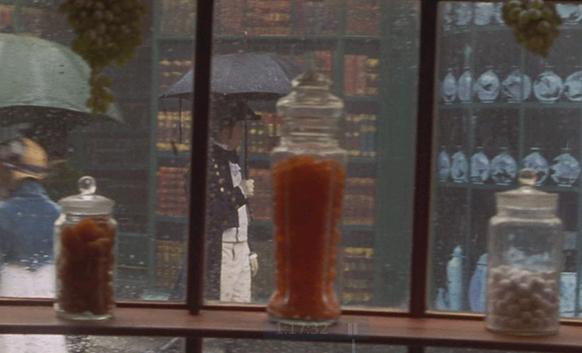
The captain is seen walking in front of a book shoppe and a shop selling imported China ware.

Anne at the instant she spots the captain.

Anne attempts to leave Molland's and encounters the Captain, who is entering the shop.

He is startled upon seeing her and they share an awkward moment. (We later learn he has come to Bath to find her.)


Truth be told, Anne is pleased with the encounter.


The following night, a rejuvenated Anne looks for the captain in the Upper Assembly Rooms. Print below: Milsom Street and the Bath Swells (Dandies) in Jane Austen's day.

Today Milsom Street is still a main shopping street, boasting banks, restaurants, pubs, clothing stores, furniture stores jewellers, book stores and department stores. And tourists.

More on the topic:

Sunday, July 18

Jane Austen's Death: Events in College Street 18th July 1817

In mid April 1817 Jane Austen was so ill she took to her bed in Chawton. By the 27th April she had written her will. After a visit from her brother James and his wife Mary she agreed to go to Winchester to be close to her surgeon who would take care of her there.


Lodgings were found in 8 College Street, Winchester, which backed on to the grounds of Winchester College and was close to the precincts of Winchester Cathedral.


At first she was able to take trips from the house in College street in a sedan chair. This was an upright box about the size of a telephone kiosk, often with glazed windows to each side and furnished with a comfortable chair. Too long vertical poles secured, one to each side by iron retaining loops, were used to carry the sedan chair and its occupant.


As you can imagine only short journeys could be attempted in this way because the chair and occupant would be heavy. Winchester is a not a big city and the cathedral and its precinct, a picturesque and shaded walk along the River Itchen which passes through the city, and the shops in the high Street, were only a short journey from the front door of 8 College Street.


Jane was also able to walk around the rooms inside the house in College Street. Jane herself was always optimistic. Cassandra was far more fearful.


In early June of 1817 James Austen wrote to his son at Oxford, “I grieve to write what will grieve to read; but I must tell you that we can no longer flatter ourselves with the least hope of having your dear valuable Aunt Jane restored to us.”


Later in the same letter James states that his sister is “….. well aware of her situation.” and also at another point he writes “…. an easy departure from this to a better world is all that we can pray for.”


All this sounds very gloomy. However, Jane’s health seemed to improve for a while to the surprise of all.


On the morning of the 15th July, St Swithuns Day Jane dictated a humorous poem to Cassandra. She must have been mulling the words over in her head. It was called, Venta, an old fashioned name for Winchester.
“Oh subjects rebellious!
Oh Venta depraved
By vice you’re enslaved…..


St. Swithun was a Saxon saint who had lived in Winchester. He was buried in the Cathedral and his grave became a focus for pilgrims coming to pray for favours. Winchester was as famous as a place for pilgrimage because of St Swithun, as Canterbury became later because of Thomas a Beckets martyrdom near the high altar in Canterbury Cathedral.. There is a famous rhyme associated with St Swithun:
'St. Swithin's day if thou dost rain
For forty days it will remain St. Swithin's day if thou be fair For forty days 'twill rain nae mair.'

However the depraved and enslaved that Jane refers to was probably about some of the characters who frequented the yearly tradition of horse racing and betting on the races that took place on St Swithun’s day to celebrate the saint. I’m sure there was some depraved activities at these Winchester races.


There is a line in the poem that is thought to have been edited by Cassandra herself as Jane dictad the poem to her.
“When once we are buried you think we are gone.”

The poem is a rhyming poem and the last word of this line,
” gone,” does not rhyme with the final word of the next couplet which is the word, “said.” The word dead fits perfectly.

[

Cassandra’s first tentative foray into editing her sister’s words. The letters came later.

On the 17th July the sun shone during the day and evening and rained at night time. Mary Austen, James’s wife ( Jane didn’t get on with her) wrote “ Jane Austen was taken for death about ½ past 5 in the evening” This was a seizure and Mr Lyford Jane’s doctor thought that a blood vessel had ruptured inside Jane’s head. Dr Lyford administered something, which Cassandra does not make clear in her letters afterwards. It was probably laudanum, a derivative of opium.


Some of the last recorded words of Jane’s are, “ God grant me patience, Pray for me oh Pray for me.” She had struggled somewhat during these last moments and had partly come off her bed. Cassandra got a stool and sat next to Jane resting her head in her lap. She sat like this for six hours before she had a rest and Mary Austen took over for the next two hours until 3am in the morning then Cassandra took over the position once again. An hour later Jane Austen breathed her last breath. She was pronounced dead at 4am. Cassandra closed Jane’s eyes.

A few days later the Salisbury and Winchester Journal wrote,
“On Friday 18th inst. Died, in this city, Miss Jane Austen, youngest daughter of the late Rev. George Austen, rector of Steventon , in the county and authoress of Emma, Mansfield park, pride and prejudice and sense and Sensibility.”

Henry, her beloved brother, wrote the words to be etched on her tomb in Winchester Cathedral. He failed to mention her literary achievements.

Cassandra was distraught at her sister’s death.

However she was able to write letters to friends and family and deal with many of the practical things needed to be done after Jane’s death. On Sunday 20th July, two days after Jane died, Cassandra wrote to fanny Knight and Cassandra expresses a lot of the emotion she must have felt.


“ I have lost a treasure, such a sister, such a friend as never can be surpassed,-She was the sun of my life, the gilder of every pleasure, the soother of every sorrow, I had not a thought concealed from her, & it is if I had lost a part of myself.”

Four days later on the 24th July Jane was buried in the north aisle of Winchester cathedral. There has been some speculation as to how she was buried in such an honoured place. Her father was a local vicar, but that would not have been sufficient to get her a burial inside the cathedral. It might have been there was a friend of the family who was part of the diocesan hierarchy who got permission as a favour.


Four days after the internment on the 28th July Cassandra got down to the business of sorting out formalities. She wrote to Anne Sharp;
“ My dear Miss Sharp, I have great pleasure in sending you the lock of hair you wish for,& I add one pair of clasps which she sometimes wore & a small bodkin which she had had in use for more than twenty years.”

A certain austere efficiency has entered Cassandra’s actions.

So Jane Austen was dead. But, she lives on.


Posted by Tony Grant, the blog author of London Calling

About Tony Grant:
I am now partly retired from teaching. I do some supply teaching but I also work as a freelance tour guide for a Canadian company called Tours by Locals.

I lead tours of the South of England for family and friendship groups. Many of the tours are tailor made to peoples personal requirements.

I was born in Southampton. From an early age my grandmother made me aware of Jane Austen. It was my grandmother who showed me the site in Castle Square where Jane lived for two years. On visits to Winchester my grandmother also showed me the house where Jane died and her tomb in the north aisle of Winchester Cathedral.

I read my first Jane Austen novel, Mansfield Park, when I was doing my Batchelor of Arts degree in the early 1970's. Having been born and brought up in Southampton, Hampshire, and now living in North Surrey, I have been able to visit, over the years many of the places Jane mentions in her letters and uses in her novels. I live very close to some of those places.

I have my own BLOG, London Calling, in which I discuss ideas and places to do with Jane. My BLOG also allows me to present one of my other passions photography. I have photographed many Jane Austen sites.

Also about this topic: