Click here to enter my other blog: Jane Austen's World.
Showing posts with label Prince Regent. Show all posts

Saturday, September 25

Neo Regency Men's Hairstyles

Roger wrote a post on Neo Regency Men's Hairstyles for the Hairstyler.com. Below are his descriptions of the Prince Regent's hairstyle and the modern version of it.


The Real Deal: King George IV had cool Regency hair. Check it out: it's typical of the period in so far as it's cropped quite short and has a distict wind-blown look about it... his hair's all combed forward onto the forehead and kind of tousled. I guess the bangs are the central element and they're cut at brow length with plenty of texture.

The Neo Regency Look: Chace Crawford's hair is an example of Neo Regency today. It's short on the back and sides with a longer textured fringe, swept forward and piecey, making his hair a bit like an updated Caesar cut too. Some hair product is essential for creating the texture and making the bangs a little wispy, but don't use too much or you'll risk looking greasy.

To read the rest of the article, go to this link.

Wednesday, August 22

Prinny's Carlton House Set

I've written posts about the Prince Regent and his lavish lifestyle before. Click here, here and here to read a few of them. The Prince's association with Jane Austen is minor but crucial: He admired her novels, and she dedicated Emma to him.

The conventional wisdom is that Austen tried to squirm out of the tribute to the Prince. Was it “incumbent on [her] to shew her sense of the Honour” by dedicating her forthcoming novel to His Royal Highness? she asked Clarke. “It is certainly not
incumbent on you” to do so, he responded, “but if you wish to do the Regent that honour either now or at any future period, I am happy to send you that permission which need not require any more trouble or solicitation on your Part” (16 November 1815). - Colleen A. Sheehan, Jane Austen Society of North America

Aside from his admiration of Jane Austen, this extravagant, dissolute prince was known for sponsoring major building and park projects that transformed London, including the renovations of Carlton House in London and the sumptuous Pavilion at Brighton. Both were designed in the neoclassical and Gothic styles we've come to associate with the Regency era's furnishings, fashion, and architecture.

Carlton House, sumptuously decorated in the height of fashionable Francophile taste in line with the prince's Whig sympathies by the important architect Henry Holland (1745–1806), was the setting for a series of the extravagant parties which the prince so loved to give, culminating in the famous Carlton House fete in 1811 on his appointment as Regent. The dazzled Thomas Moore wrote to his mother about this fete, detailing the delights of the indoor fountain and the artificial brook that ran down the centre of the table, and concluding, ‘Nothing was ever half so magnificent. It was in reality all that they try to imitate in the gorgeous scenery of the theatre’ (quoted in Hibbert, 1973, p.371). (A Prince at Seaside, Learning Space)

(Image from Old London Maps)

You can view some of the rooms at Carlton Hose, such as the crimson drawing room, in this link to Decorative Arts and Design History in this link.


Blue Closet, Carlton House, The Royal Collection

The Prince Regent's friends were also known as the 'Carlton House Set.' Read a detailed description of the Prinny's high roller friends in this link: The Prince Regent and His Set from the Georgian Index.

From left to right depicted are the Earl of Sefton, The Duke of Devonshire, Lord Manners, "Poodle" Byng, Byng's poodle (name unknown), and the Duke of Beaufort.

Post script: Today is the one-year anniversary of this blog! Since early April of this year, over 20,000 of you have dropped by to visit, and I want to thank you for your support.

Thursday, February 1

The Falling Out Between The Prince Regent and Beau Brummell

It is an historical fact that the Prince Regent and Beau Brummel had a falling out. The actual events are not known for sure, but here are two knowledgeable sources that speculate as to the nature of the rift.

In The Most Polished Gentleman, Cynthia Campbell writes, "There had been frequent minor quarrels in the past; one was in the Pavilion, when, as Captain Gronow recounts, Brummell had thrown his snuffbox onto the fire after the Bishop of Winchester had unthinkingly helped himself from it. The Regent, who, Gronow said, had a great reverence for Bishops, considered this action an unforgivable insult. They were never close after this, although they continued to meet." p.133

In The Wits and Beaux of Society, Grace Wharton and Philip Wharton write,

"A quarrel did take place between George the Prince and George the Less, but of its causes no living mortal is cognizant: we can only give the received versions. It appears, then, that dining with H.R.H. the Prince of Wales, Master Brummell asked him to ring the bell. Considering the intimacy between them, and that the Regent often sacrificed his dignity to his amusement, there was nothing extraordinary in this. But it is added that the Prince did ring the bell in question—unhappy bell to jar so between two such illustrious friends!—and when the servant came, ordered 'Mr. Brummell's carriage!' Another version palms off the impertinence on a drunken midshipman, who, being related to the Comptroller of the Household, had been invited to dinner by the Regent. Another yet states that Brummell, being asked to ring the said bell, replied, 'Your Royal Highness is close to it.' No one knows the truth of the legend, any more than whether Homer was a man or a myth. It surely does not matter. The friends quarrelled, and perhaps it was time they should do so, for they had never improved one another's morals; but it is only fair to the Beau to add that he always denied the whole affair, and that he himself gave as the cause of the quarrel his own sarcasms on the Prince's increasing corpulency..."

Carlton House


Cynthia Campbell goes on the say, "There was a final encounter. While waiting for their carriages after the opera, in a great crush, they came close. An eyewitness reported that Brummell was about to bump into the Regent. "In order to stop Brummel, therefore, and prevent an actual collision, one of the Prince's suite tapped him on the back, when he immediately turned sharply round, and saw there was not more than a foot between his nose and the Prince of Wales'. I watched with intense curiosity, and observed that his countenance did not change in the slightest degree nor did his head move; they looked straight into each other's eyes, the Prince evidently amazed and annoyed. Brummell, however, did not quail or show the least embarrassment. He receded quite quietly, and backed slowly step by step till the crowd closed between them, never once taking his eyes off those of the Prince....

By 1816 Brummell had such heavy gambling losses that he had to leave England to escape arrest for debt. He lived for many years in Calais, and later in Caen. With sad irony, the old age of the prince of dandies, the paragon of cleanliness, was one of imbecility, decrepitude, and disease. "His habits were so loathsome that an attendant could hardly be found for him." He died in a Caen asylum in 1840.


For a humorous doggerel recounting the rift, click on the link below:


Prince Regent According to Albert Igginbottom

Saturday, December 2

Brighton Pavilion


In Xanadu did Kubla Khan
A stately pleasure-dome decree :
Where Alph, the sacred river, ran
Through caverns measureless to man

Down to a sunless sea.

So twice five miles of fertile ground
With walls and towers were girdled round :
And there were gardens bright with sinuous rills,
Where blossomed many an incense-bearing tree ;
And here were forests ancient as the hills,
Enfolding sunny spots of greenery.
--Samuel Taylor Coleridge


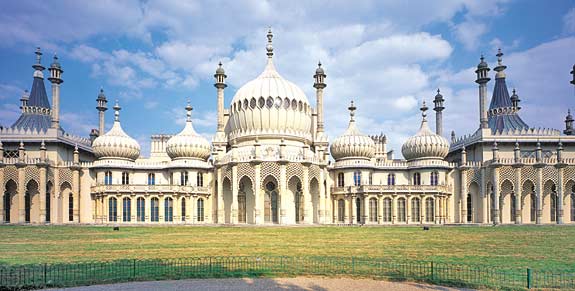
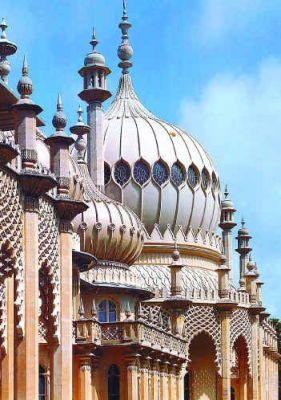
When I visited Brighton Pavilion in Brighton, a charming seaside town in Sussex's South Downs, I found it more beautiful and fantastic than the drawings, paintings, and photos I'd seen. The building, rebuilt between 1815-1822 by John Nash, the Prince Regent's architect, is starkly white and stands in the center of town. Approaching it on foot, one is astounded by the intricacy of the architectural details, from the exterior domes, spires, and columns, to the interior with its gothic touches, fantasy rooms, and exquisite color combinations and patterns.

The Prince Regent was known for his excesses and expensive tastes, and his architect John Nash succeeded in fulfilling the Prince’s most outrageous wishes. The Gothic Revival was in full swing during the Regency Era, including the love for all things mid-Eastern, Chinoise, and Arabian. This Arabian Nights fantasy in stone has been well documented in picture books and on the web. I will merely point out a few spectacular rooms and some of the details that struck me as being particularly beautiful or unusual.

The kitchen, a cavernous room created to comfortably accommodate the Prince's idea of an intimate dinner, is depicted on this web page. Click here and scroll down to the kitchen. You can also see a panoramic view of the kitchen on the page if you have a real player. It was not unusual for the Prince to throw a banquet with 36 courses, hence the kitchen was designed to accommodate the scores of cooks and enormous amounts of food stuffs and ingredients required to prepare these foods.

The long gallery is indeed long. The colors are riotous, and one feels as if one is traipsing through a fantasy land.


On the left is a picture of John Nash's long gallery. On the right is a photograph of the long gallery today.

The banquet room also lingers in my memory, with its long, long banqueting table, the exquisite details in the ceiling, and the fantastic carved dragons peeping out from chandeliers disquised as palms.


Salon & Music Room


Images of Brighton in the 19th Century:
Evening Gathering at Brighton Pavilion in the Yellow Room


Brighton, a seaside resort