Click here to enter my other blog: Jane Austen's World.
Showing posts with label London. Show all posts

Saturday, April 30

The Royal Wedding From the Sidewalks of London

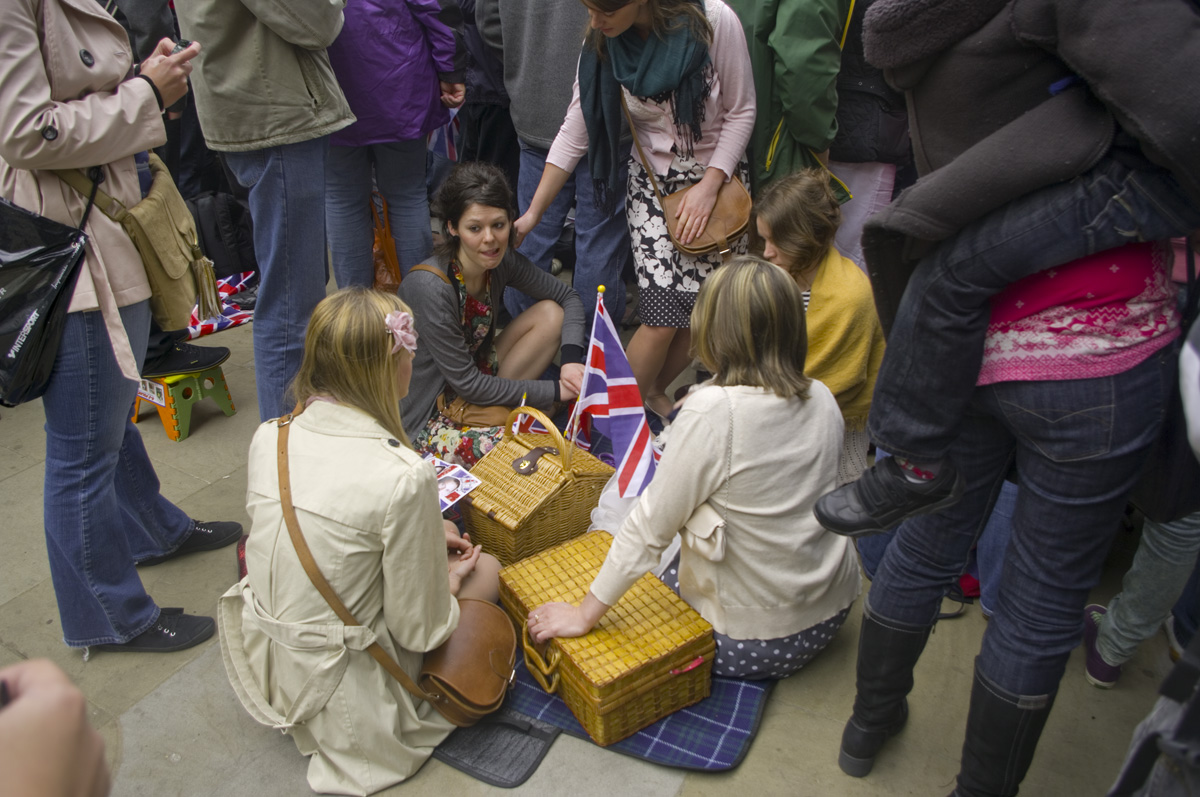
Gentle readers: Frequent contributor Tony Grant managed to take the train into London with his lovely wife, Marilyn, and take images as a by-stander. His pictures will give you an idea of how fleeting their glimpses of Prince William and Kate Middleton were as the newly wed couple rode past the crowd in the 1902 state landeau. But Tony also captured the excitement of being among the crowd on a memorable and festive occasion. Thank you, Tony, for being our roving ambassador! While you are here, do vote for Kate's (Duchess of Cambridge's) gown in the post below.
Crowds near Westminster Abbey
Tony captured the image I have in my mind of a typical seasoned British lady

All glammed up as a walking advertisement for Tesco

In the thick of the crowd

Tony thinks this is Prince Charles and Camilla. This is about all of Camilla that I want to see.

One of many marching bands. The Brits do know how to put on a good show.

The chap (front right) is momentarily distracted. The horses are not.

Lovely shot. I can picture my mom with these ladies.

Thankfully it did not rain, but these ladies were prepared!

These images remind me of why I stay at home to watch parades on the telly.


Tony thinks this is Charles and Camilla
If you click on this image, you can see Princess Beatrice leaning forward. Too bad her Philip Traecy "Antler" hat is not visible!
Oh, dear. Good or bad? You decide. Image @The Daily Mail

After all that waiting, here is Tony's image of the bride. You can barely see her at the left.

Tony says that he stood higher than the top people on this statue

Biking from Jamaica?

Grabbing a bite to eat. But where is the loo?

Whitehall

These two ladies look smart

Buckingham palace in the distance

About the time of the kiss, these planes flew overhead

Tony's wife, Marilyn

Tony in a quiet section of Whitehall

This Bobby must be tired of standing on his feet for hours watching the crowds

Sunday, August 15

Jane Austen Throwdown

The settings that Jane Austen chose for her characters were important to her plot. Much of Northanger Abbey was set in Bath, Elizabeth and the Gardiners traveled to Derbyshire where Pemberley lay, Lydia got into trouble in Brighton, and Box Hill, where Emma was so rude to Miss Bates, is set in Surrey.

We now ask you to choose two of your favorite Jane Austen locations. Bath or London? Steventon Rectory or Chawton Cottage?

Two of Your Favorite Jane Austen Locations


Bath, an ancient city, whose Roman Baths and drinking waters attracted rich and poor alike. It was said that more doctors and apothecaries were licensed in Bath than any other city in Great Britain.


London, the largest city in Europe in Jane's day. She would visit her brother, Henry, who lived in town and acted as her agent. Jane most particularly liked London's parks and gardens, and would frequent the shops, bringing back items for her family.


pollcode.com free polls
Bath or London?
Bath London


Steventon Rectory. Jane spent most of her childhood in Steventon Rectory. Here is where she learned to write, and where her close-knit family nurtured her talent. When she learned that her parents had made plans to move to Bath and from a home she loved, Jane fainted.


Chawton Cottage was refurbished by Jane's rich brother Edward, who invited her, Cassandra, and Mrs. Austen to live there. Jane spent her most productive writing years during her time in Chawton, revising Pride and Prejudice, Sense and Sensibility, and Northanger Abbey, and writing Emma, Persuasion, and Mansfield Park. She began Sanditon there, completing 11 chapters before succumbing to her fatal illness.


pollcode.com free polls
Steventon Rectory or Chawton Cottage?
Steventon Rectory Chawton Cottage


Wednesday, August 15

The Royal Academy at Somerset House

During Jane Austen's time, a trip to London would have most likely included a visit to the great painting exhibitions of the Royal Academy. This august selection of painters, sculptors, and architects moved from their location in Pall Mall to Somerset House in 1768. Sir Joshua Reynolds, the first president, presided over forty members.

View of Somerset House from the Thames

The steep curved Nelson Steps in Somerset House took visitors up to the Great Room, a domed area roughly 53 x 43 feet and 32 feet high, where the oil paintings were hung.

Rowlandson, whose satiric illustration of the Nelson Steps was shown on a previous post on this blog, drew a crowd "Viewing Art" in the illustration above. The exhibits increased from 547 paintings and sculptures in 1781, to1,037 in 1801, and 1,165 in 1821. Eventually the paintings were hung from floor to ceiling, and according to the order of "importance," the best were hung nearest the midline of the room.

The purchase of catalogues became mandatory in 1761 in order to view an Academy exhibition. Their cost was one shilling, which would prevent a certain class of visitors from attending academy shows. As with today's audio and visual museum guides, these catalogues would direct museum goers to certain paintings and sculptures, thereby directing the movement of the crowd.

Dr. Samuel Johnson noted in his diary about the first pre-exhibition banquet: The Exhibition! how will you do either to see or not to see? The Exhibition is eminently splendid. There is contour and keeping and grace and expression, and all the varieties of artificial excellence.

The apartments were truly very noble. The pictures for the sake of the skylight are at the top of the house: there we dined and I sat over against the Archbishop of York.

The Academy moved to new quarters in Trafalgar Square, and the last academy exhibition at Somerset House was held in 1836.

Sunday, July 1

Shopping in London during Jane Austen's Time


Linen drapers, such as Harding and Howell in Pall Mall, were extremely important in an era when clothes were sewn by hand. In 1811, Jane Austen described a shopping expedition she made to a London establishment that sold handkerchiefs, gauzes, nets, veils, trims, and cloth:

We set off immediately after breakfast and must have reached Grafton House by 1/2 past 11 -, but when we entered the Shop, the whole counter was thronged & we waited a full half an hour before we c'd be attended to. When we were served however, I was very well satisfied with my purchases.

A century before Jane's shopping expedition, London shopkeepers began to spruce up their shop fronts and displays to attract customers. Large bow-windows, such as the silk merchant's in the image above from Spitalfield, allowed for the entry of light as well as an attractive space for the display of goods. By the end of the 18th century, it was estimated that around 200 different types of shops could be found in London. Shops tended to be open for long hours, from around seven AM until seven or eight PM. These hours were perhaps one of the reasons why shopkeepers and their assistants tended to live on the premises, with a shop area in front and a parlor behind.

Shops also tended to be grouped. For instance, the ladies of the Ton frequented fashionable shops Oxford Street or Bond Street located in Mayfair, whereas the shops and clubs for gentlemen were clustered in St. James's. The discerning shopper could also purchased goods at warehouses in Covent Garden, mercers and linen drapers in Cheapside, and new shops in the Strand. A number of shops from that era still thrive today. Berry Brothers Wine Shop in St. James's was founded in 1698 and remains essentially unchanged since its founding, as the interior above attests. Locks, the hatters in St James's, also founded in the seventeenth century, still makes hats and bowlers for the fashionable set. And Floris , a fragrance shop Beau Brummel frequented, can still be found on Jermyn Street.Shop keepers advertised through circulars, trade cards, newspaper notices, or board-men, who were employed to roam the streets. In the 1760's, the large shop signs that had once hung over shops and identified the shop's merchandise to a populace that largely could not read were deemed hazardous. They were removed by law, but a few managed to survive, as this account in the Book of Days describes:

In Holywell-street, Strand, is the last remaining shop sign in situ, being a boldly-sculptured half-moon, gilt, and exhibiting the old conventional face in the centre. Some twenty years ago it was a mercer's shop, and the bills made out for customers were 'adorned with a picture' of this sign. It is now a bookseller's, and the lower part of the windows have been altered into the older form of open shop. A court beside it leads into the great thoroughfare; and the corner-post is decorated with a boldly-carved lion's head and paws, acting as a corbel to support a still older house beside it. This street altogether is a good, and now an almost unique specimen of those which once were the usual style of London business localities, crowded, tortuous, and ill-ventilated, having shops closely and inconveniently packed, but which custom had made familiar and inoffensive to all; while the old traders, who delighted in 'old styles,' looked on improvements with absolute horror, as 'a new-fashioned way' to bankruptcy.

Learn more about shopping during the Regency Era in the following links:


Texts:

Eighteenth Century London, Nichola Johnson, ISBN 0-11-290448-3

A Frivolous Distinction: Fashion and Needlework in the Works of Jane Austen, Penelope Byrde, Bath City Council, ISBN 0-901303-09-7

High Society, Venetia Murray, ISBN 0-670-85758-0

Sunday, January 7

London - Pall Mall Club Land

"As Pall Mall and the immediate neighbourhood of St. James's have been for a century the headquarters of those London clubs which have succeeded to the fashionable coffee-houses, and are frequented by the upper ranks of society, a few remarks on Club-land and Club-life will not be out of place here.As Walker observes in his "Original," the system of clubs is one of the greatest and most important changes in the society of the present age from that of our grandfathers, when coffee-houses were in fashion. "The facilities of life have been wonderfully increased by them, whilst the expense has been greatly diminished. For a few pounds a year, advantages are to be enjoyed which no fortunes, except the most ample, can procure. … For six guineas a year, every member has the command of an excellent library, with maps; of the daily papers, London and foreign, the principal periodicals, and every material for writing, with attendance for whatever is wanted. The building is a sort of palace, and is kept with the same exactness and comfort as a private dwelling. Every member is a master without the troubles of a master. He can come when he pleases, and stay away as long as he pleases, without anything going wrong. He has the command of regular servants, without having to pay or to manage them. He can have whatever meal or refreshment he wants at all hours, and served up with the cleanliness and comfort of his own home. He orders just what he pleases, having no interest to think of but his own. In short, it is impossible to suppose a greater degree of liberty in living."

From: 'Pall Mall; Clubland', Old and New London: Volume 4 (1878), pp. 140-64. URL: http://www.british-history.ac.uk/report.asp?compid=45188. Date accessed: 07 January 2007.

This site leads you to views of London today. Explore the sights in panoramic views.

Wednesday, January 3

Greenwood's Map of London


Published in 1827 after surveying every square mile of London, Greenwood offered his detailed map to subscribers. You can observe in this small detail a corner of Hyde Park, Park Lane, Grosvenor Square and a part of Berkeley Square, Green Street, Upper Brook Street, and other familiar Mayfair landmarks

This online map, hosted by Bath Spa University, is interactive. Click here to find it and other information about the development of this wonderful tool.


Click here to find an interactive map of London during Charles Dickens time.

Wednesday, August 30

John Nash, the Architect Who Transformed London


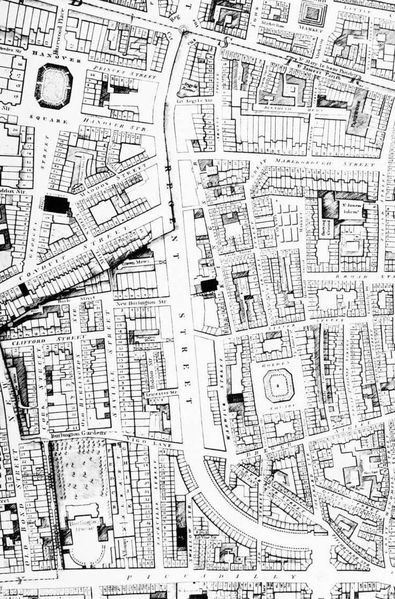
John Nash's buildings exemplified the neoclassical style of early 19th Century Architecture. His sweeping changes transformed London, from the graceful curve of Regent Street to the majestic terraces and vistas in Regent's Park.

View some of his edifices below:

1. Regent's Park
2. Regent Street
3. Buckingham Palace


We will devote an entire section to Brighton Palace later.