Click here to enter my other blog: Jane Austen's World.

Saturday, April 30

The Royal Wedding From the Sidewalks of London

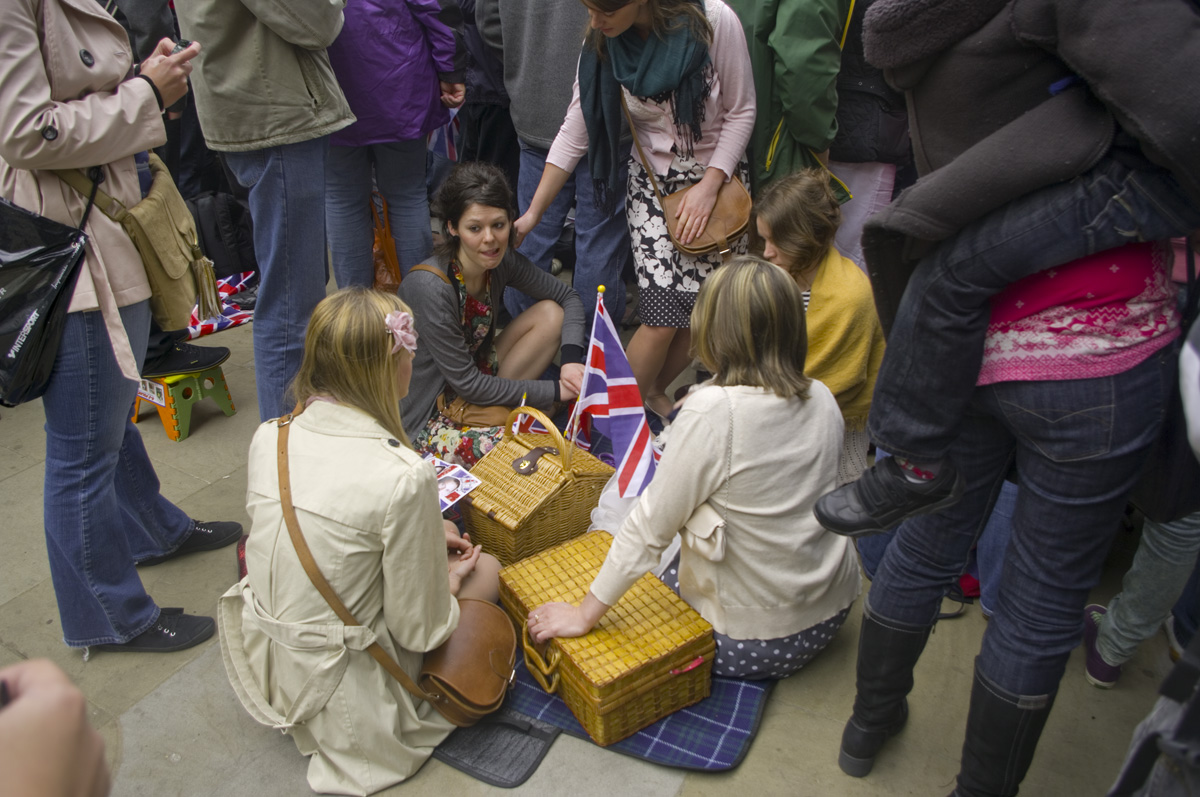
Gentle readers: Frequent contributor Tony Grant managed to take the train into London with his lovely wife, Marilyn, and take images as a by-stander. His pictures will give you an idea of how fleeting their glimpses of Prince William and Kate Middleton were as the newly wed couple rode past the crowd in the 1902 state landeau. But Tony also captured the excitement of being among the crowd on a memorable and festive occasion. Thank you, Tony, for being our roving ambassador! While you are here, do vote for Kate's (Duchess of Cambridge's) gown in the post below.
Crowds near Westminster Abbey
Tony captured the image I have in my mind of a typical seasoned British lady

All glammed up as a walking advertisement for Tesco

In the thick of the crowd

Tony thinks this is Prince Charles and Camilla. This is about all of Camilla that I want to see.

One of many marching bands. The Brits do know how to put on a good show.

The chap (front right) is momentarily distracted. The horses are not.

Lovely shot. I can picture my mom with these ladies.

Thankfully it did not rain, but these ladies were prepared!

These images remind me of why I stay at home to watch parades on the telly.


Tony thinks this is Charles and Camilla
If you click on this image, you can see Princess Beatrice leaning forward. Too bad her Philip Traecy "Antler" hat is not visible!
Oh, dear. Good or bad? You decide. Image @The Daily Mail

After all that waiting, here is Tony's image of the bride. You can barely see her at the left.

Tony says that he stood higher than the top people on this statue

Biking from Jamaica?

Grabbing a bite to eat. But where is the loo?

Whitehall

These two ladies look smart

Buckingham palace in the distance

About the time of the kiss, these planes flew overhead

Tony's wife, Marilyn

Tony in a quiet section of Whitehall

This Bobby must be tired of standing on his feet for hours watching the crowds

Friday, April 29

What did you think of Kate Middleton's (Duchess of Cambridge's) wedding gown?

The dress was made of ivory and white satin gazar, a loosely woven silk, with the skirt echoing an opening flower, with white satin gazar arches and pleats and a train measuring 2.7 meters (9 feet). The ivory satin bodice, which is narrowed at the waist and padded at the hips, draws on the Victorian tradition of corsetry and is a hallmark of McQueen’s designs, Prince William’s office said. - Bloomberg
Royal Wedding Dress: Kate Middleton
Adored it
Liked it
Thought it was ok
Too simple
Didn't like it at all


pollcode.com free polls


Route of the Royal Wedding

This map might help you keep track of where Wills and Kate are on their nuptial day. The schedule sits in the sidebar. Click on the map for a larger image. Courtesy The Telegraph.


Westminster Abbey. Image @Daily Mail

Thursday, April 28

Northanger Abbey: Spring Rewatch

Dear readers! you know you want to join in! What are we rewatching this time? The 2007 version of Northanger Abbey.

When: April 29, 2011 @ 8pm EST (Yep. The day of the Royal Wedding. I know, I'll be half dead too ;) )

Where: Twitter: #REanger
look for @heatherfrances and all the rest of the fantastic rewatch group: @CaseeMarie, @Ladyrelaynie, @darbydashwood, @sheblog, and @so_meow

Who: Everyone!

Why: Because we can. And its an absolutely adorable Austen drama. There are only 2 twitter rewatches left for the season! Get into the last 2 before its too late!

Incentive: Like with the S&S rewatch, I will be posting rewatch-only wallpapers and photos. Feel like showing off your photoshop skills too? The more the merrier! Stop by and tweet your fan art. We love sharing!

Check back the day of for youtube links and more. RSVP on Rusty Sarcasm's facebook page to get a special wallpaper.

Tuesday, April 26

Watch the Royal Wedding on YouTube!

Gentle Readers, blog contributer, Raquel Sallaberry, contributed this YouTube invitation to the Royal Wedding. Will you be watching? I will take a peek before work, but alas and alack, I must pay the mortgage and for the kibbles and bits my dog swallows by the pound, and shall have only an hour or two to see the festivities.

Flora of the Regency: Paper Doll Series

Flora of the Regency is the latest paper doll created for Paper Thin Personas. She comes with an extensive wardrobe too. What I like about this particular series is that the doll and dresses are in black and white and can be downloaded in PDF format. Little girls can color this series with crayons before cutting out the dresses and playing with their doll. How cool is that?

Flora's ballgown


Flora's half dress and day dress

Monday, April 25

Scents and Sensibility

The trailer is out; the movie can't be far behind in this year of Sense and Sensibilities' 200 year anniversary.


Learn more about the film in this post on Jane Austen's World, contributed by Adriana Zardini.

Here's a link to the Facebook page.

Sunday, April 24

A Jane Austen Education, new book coming by William Deresiewicz

Gentle Readers, for several years my blogs have covered Jane Austen from the male perspective. Most recently, Tony Grant wrote about Sense and Sensibility's two hundred year anniversary and how he discovered Jane Austen. Several years ago, Laurel Ann and I reviewed Two Guys Read Jane Austen, and I wrote a blog post, Men Reading Jane Austen. A new book, A Jane Austen Education, by William Deresiewicz is about the be released. In modern parlance, it's raining men in the JA community! Here's an interview with Mr. Deresiewicz on Amazon.com:

Author Q&A with William Deresiewicz:

Q: Can you describe your initial resistance, as a young graduate student, to reading Jane Austen?

A: Like a lot of men, I thought Austen was chick lit: soap-opera romance, fluffy and boring. When a friend of mine heard I was writing this book, he said “I expect a lot of sex and dating advice.” It was an understandable assumption, and my friend’s, no doubt, was based on all those movies—the ones with the beautiful gowns, and the beautiful homes, and the beautiful actresses. The ones with all the swoony music and the lush, romantic lighting, the ones that leave out everything that Austen had to say to us except the love—and then, don’t even get the love part right.

Q: What most surprised you about yourself once you discovered Austen's novels and started examining your own life?

A: If you had told me, when I was eighteen or twenty or twenty-five, that the most important writer I would ever come across would be Jane Austen, I would have said you were crazy. Why should half a dozen novels about provincial young English ladies, published in the 1810s, make any difference whatsoever to a Jewish kid in New York in the 1990s? But I learned that books aren’t written by groups, and they don’t belong to groups. They’re written by individuals, speaking to individuals, and they belong to anyone who loves them.

What was Austen saying to me? Well, first of all, what an idiot I had been about so many things--about pretty much everything to do with relationships. And that I had so much to learn from seeing things from a woman's point of view. But most of all, finally, I think, that I didn't have to be afraid to learn things about myself--didn't have to be afraid, in other words, to be wrong. Aside from all the specific lessons, I think the largest message was simply that I no longer had to be so armored, so defended, so defensive. And that's made it easier to admit mistakes and be vulnerable and keep on growing.

Q: Is that when you came up with the book’s subtitle, How Six Novels Taught Me about Love, Friendship, and the Things that Really Matter?

A: Well, a while ago, I was interviewing for a job as an English professor. At the very end, the head of the hiring committee posed a question that she must have been dying to ask me the whole time. Glancing down at my resume—I had written my doctoral dissertation on The Novel of Community from Austen to Modernism, published a book entitled Jane Austen and the Romantic Poets, and was planning a study called Friendship: A Cultural History from Jane Austen to Jennifer Aniston—she asked, “So what’s with you and Jane Austen?”

I wanted to give [the dean] her a good answer. But how do you explain your deepest attachments? I tried to muster an intellectually sophisticated response, something about the purity of Austen’s prose or the brilliance of her satire, but it didn’t feel right, and besides, I’d already given enough answers like that. Finally, I just blurted something that I’d already been telling myself for a long time. “Well,” I said, “sometimes I feel like everything I know about life I learned by reading Jane Austen.”

Click here to read the rest of the review and to preorder the book.

Saturday, April 23

Regency Easter Bonnets

1823
Oh, how I love these bonnets. Happy Easter, all! For a post I wrote last Easter, please click on this link to Jane Austen's World.

Thursday, April 21

Pride and Prejudice Cover by Anne Benjamin


For the past seven years, Katie Cromwell and Jensen Carp at Gallery 1988 have been showcasing pop culture-themed artwork to a new generation of LA residents. This month Cromwell and Carp are exhibiting (and selling) 45 limited-edition posters inspired by novels we all know and love, curated by OMGPosters and Rob Jones - Huffington Post


Wednesday, April 20

My Pride and Prejudice and Zombies Conspiracy Theory Continues

Pride and Prejudice and Zombies
Gentle Reader, I have caught the Oliver Stone bug of seeing a conspiracy wherever I look. Take Pride and Prejudice and Zombies, for instance. I wrote a paranoid post about this film, thinking that it will probably never be made, for all the published reports about changes in actors and directors reeked of publicity and promo. The latest news is that Craig Gillespie will direct this film and that he is "close to signing on the dotted line." Well, this article seems to confirms that he will direct Pride and Prejudice and zombies.

The announcement totally kills my conspiracy theory. I have mentioned that the publicists are quite careful in promoting the pre-publicity of this film, and have included using such qualifiers such as “possible”, “rumored”, “battling for”, “may tackle”, “under consideration”. "Close to signing" is another gem in this PR lexicon.
Craig Gillespie, director?
So, will Craig actually direct this film? Or is this another way of keeping the franchise of Pride and Prejudice and Zombies in the public eye? Does the following statement from MovieWeb contain qualifiers? I would say yes - at least two. "It isn't clear', and "seems they are ramping up."
"It isn't clear when production will begin on Pride and Prejudice and Zombies, although with a director finally locked in, it seems they are ramping up to start filming soon."

Monday, April 18

Sense and Sensibility: Two hundred years this year

Gentle readers, frequent contributor Tony Grant wrote this post for Raquel Sallaberry's blog, Jane Austen em Português. Raquel has generously agreed to let me publish this post, which Tony sent in English.

This year is the two hundredth anniversary of the publication of Sense and Sensibility. Jane Austen started writing this novel of youth and naivity when she was nineteen years of age. It is an exploration of a teenagers emotional pain and mistakes made.

Castle Square today

I first became aware of Jane Austen at an early age. I was born and brought up in Southampton on the south coast of England. Southampton was the town Jane lived in with her mother, her best friend Martha Lloyd and her brother frank’s wife , Mary. They moved into a house in Castle Square during the year of 1806. It had a high position behind the ancient medieval walls of the town overlooking a great bay where centuries before Henry V and his troops had set sail from for France and victory at Agincourt. They had a magnificent view of the New Forest in the distance.

18th century white house is Tony's school
When I was a little boy my grandmother pointed out the pub called the Juniper Berry and now called the Bosuns Locker which is on the sight of the house where Jane lived with her family. I also went to school in Bitterne and attended St Mary’s College which is situated on a hill overlooking a valley with the Portsmouth Road running through it. On the other side of the valley used to be the estate of a family called the Lances.
Little Lance's Hill on part of the Lance's estate
Jane Austen became friends with the Lances while living in Southampton, attended balls at the Dolphin Hotel in the high street with the Lance daughters and visited their house for tea and admired Mrs Lance’s pianoforte. From my classroom I could look out on Lances Hill on the opposite side of the valley and was told on more than one occasion by my English teacher that Jane Austen had been there. So from a very early age I was aware of Jane Austen.
The Dolphin Hotel
I didn’t read any of her novels until in 1975 I was doing a degree in English literature. One of my units was a course on the 19th century novel and we had to read Mansfield Park. I loved getting to grips with the structure of Mansfield Park and the meanings in the novel. As the years went by I visited Winchester many times. I got to know Chawton well, paying homage to Jane, and adding, over the years, layer after layer of knowledge and developing responses to our Jane.

It wasn’t until about five years ago I set about reading all of Jane’s novels including Sanditon, getting to grips with her letters and reading Claire Tomlin’s excellent biography of Jane.
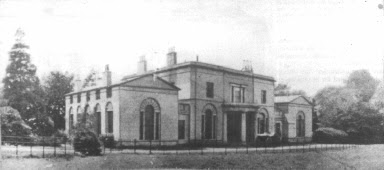
Chesil House, the home of the Lances
Sense and Sensibility is of special importance to me because I think, one of the things Jane enables us to do in all her novels is hold a mirror up to ourselves. Her novels help us reflect on ourselves. Sense and Sensibility does this especially for me through the character of Willoughby. He reminds me of my dissolute youth, perhaps drinking too much , looking out for a good time always, and seeing attractive women merely as a good lay. I too was superficial. I empathise with his pain as maturity and knowledge of his true love dawns on him. Willoughby was unlucky because he made too many fatal mistakes and lost Marianne. I was far luckier. I met my wife, Marilyn, and she changed me. It felt, just right, deep down when I met her. We made a connection. It is still right 29 years and four children later. The superficiality of my early relationships, often as exciting as exploding fireworks, were no more than that, a bright sparkling explosion and then nothing.
Carried her down the hill. Brock image @Molland's
Thank you Jane for writing Sense and Sensibility and thank you Willoughby for reminding me what could have happened. All men should read Sense and Sensibility for their own good.

Saturday, April 16

Royal Weddings by Emily Brand: A Review and Poll

It is a fact not universally known that Westminster Abbey became the regular setting for royal British weddings in 1919 and 1922, when Princess Patricia of Connaught (granddaughter of Queen Victoria) and Lady Elizabeth Bowes-Lyon were respectively married to commoner Alexander Ramsay and the future King George VI. The enormous interior of that magnificent edifice allowed the two couples to invite an impressive number of guests to witness their nuptials.
Queen Elizabeth II and Prince Phillip celebrate their 60th wedding anniversary in Westminster Abbey. Image @CBC News
Young Queen Victoria settled on the more traditional but cramped setting of St. James's Palace, since prior to the 20th century, royal weddings were consider private affairs.
Queen Victoria and Prince Albert
In a few weeks, Westminster Abbey will host a royal wedding for the 38th time. Royal wedding fever has gripped the world, as evidenced by the proliferating number of merchants seeking to make a profit with souvenirs of questionable taste. These tacky tchotchkes have been around for a long time - as early as 1625, when profile portraits of Charles I and Henrietta Maria were set on tokens to commemorate their wedding.
Excellent example of a tchotchke
In honor of Will's and Kate's most splendid (and expensive) occasion on April 29th, Shire Library has released Royal Weddings by Emily Brand. This short but tasteful, 56-page book is crammed with useful information and images (some quite rare) that explain the evolution of royal marriages from those that united the children of Britain's ruling families for princely gain, not personal satisfaction – to the modern era, where quite a few personal choices based on love led disastrously to divorce.

George V and Mary of Teck on their wedding day in featured in The Illustrated London News, 15 July, 1983
Emily Brand is a writer and historian with a special interest in eighteenth- and nineteenth-century England. In Royal Weddings she chronicles the pomp and splendour of royal marriages since 1066 in a slim and sleek 56 page book that is generously enhanced with 60 full-color pieces of rare art and images of elaborate decorations, feasts and wedding cakes; ornate jewelry; commemorative medallions; evolving wedding fashions; marriage announcements; and menu card. Many juicy historical tidbits are sprinkled throughout the book, but for the sake of brevity, I shall concentrate on trivia from the Georgian era:
When not in the mood, close your eyes and think of England! The prolific George III and Charlotte.
While Charlotte of Mecklenburg-Strelitz was far from attractive, George III remained loyal to her and did not take a mistress for the entirety of their marriage. Alehouses advertised Mecklenburg purl and Coronation porter in honor of the event.
Gillray's cartoon of the bridal night. 1797.Wedding night of Charlotte Augusta Matilda, Princess Royal and Prince Frederick William Charles of Wurtemberg; Duke of York, Clarence and Gloucester
The Prince Regent (future George IV) was quite drunk during the marriage ceremony, and had to be supported as he walked down the aisle. Despising his bride, Princess Caroline of Mecklenburg, on sight, he spent his wedding night inebriated and unconscious. Nevertheless, he performed his duty early, for nine months later, Caroline gave birth to their only child, Princess Charlotte.He was never to enter their marital bed again. The above cartoon depicts the lack of privacy royals enjoyed on their wedding night.
Princess Charlotte's marriage to Prince Leopold was short but happy. After her death he sincerely grieved for her.
Princess Charlotte managed to be happy in her marriage to Prince Leopold, but their wedded bliss lasted less than two years when she died in agony giving birth to a stillborn son. Her death sparked a flurry of weddings in which the King's bachelor brothers married in hopes of producing an heir. While King George III and Queen Charlotte were prolific, their fifteen children were not. It was the Duke of Kent's daugher, Victoria, who would ascend to the throne.


"The cartoon above shows Princess Charlotteon her wedding night in her bed, throwing her stocking to the four old maid aunts (the daughters of George III). Her husband, Prince Leopold of Saxe-Coburg, is impatiently peeping round the door. The depicted aunts were kept unmarried first by their father, then by their mother to buffer her from their father in his "madness". Kew Palace became renowned for being home to these sisters, unmarried against their will." - From Culture 24 - Exhibit at Kew Palace 


I must admit that I thoroughly enjoyed reading this book and recommend it to anyone who has been smitten with Royal Wedding fever. Order the book here from Random House.

My question to you, gentle reader, is this: “Will you be one of the one billion people to watch the nuptials on television?”


Will you watch the royal wedding on TV April 29th?
Yes
No
Perhaps


pollcode.com free polls

More on the topic: