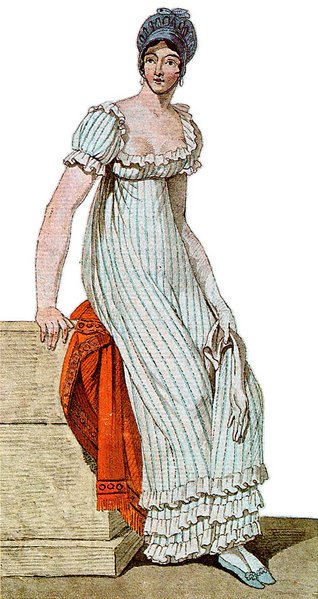
Lisa's Guide to Helping a 21st Century Woman Dress for a Regency Ball provides four pages of advice and instructions on how to dress for a ball. Detailed illustrations are included.
Click here for similar posts:


 Excerpt is directly from the Regency Project, an amazing reproduction fashion site.


 Also on the site, an embroidered French silk purse, c.1780-1800 with the words, "Quand on aime tout est plaisir." Plaisir? Oh, yes. How true.
 In the first plate, The Stays, Gillray depicts a young lady in her undergarments and wearing a cap, stockings, and slippers. On the floor sit a bowl and pitcher with water. Toiletries, pins, and jewelry are scattered on top of her dressing table. She inserts a busk between her breasts as her maid tightens her stays. Find a more detailed explanation about regency undergarments and regency fashions by clicking on the bolded words.
 In the third engraving, Dress Completed, we observe our young lady dressed for the evening and putting on evening gloves, which, typical of the day, are loose at the top. Her maid holds a shawl and fan, and her reticule hangs on a hook on the wall. The side table is no longer visible; her fashion plate book/magazine lies discarded on the floor. Our young lady's slippers probably looked like this pair below. For a comprehensive view of footwear during this era, click here.
 In The Mirror of Graces, 1811, a Lady of Distinction write, "Perhaps it is necessary to remind my readers that custom regulates the veiling or unveling the figure, according to different periods in the day. In the morning the arms and bosom must be completely covered to the throat and wrists. From the dinner-hour to the termination of the day, the arms, to a graceful height above the elbow, may be bare; and the neck and shoulders unveiled as far as delicacy will allow."
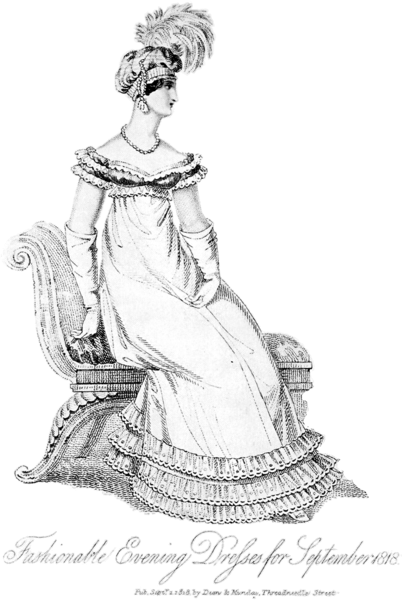 Describing the exquisite Regency gowns in its collection, The Museum of Costume & Assembly Rooms, Bath: The Official Guide states on p 32:
Find a listing of fabric and cloth on the Phrontistery site:
"This is a rather odd category, listing 269 names of kinds of fabric and cloth. There is an enormous variety in fabrics, with many different national, historical and regional varieties. It is interesting to note, however, that almost all of the types of fabric listed below are variants or blends of just five basic fabric types (silk, cotton, linen, wool and worsted)."